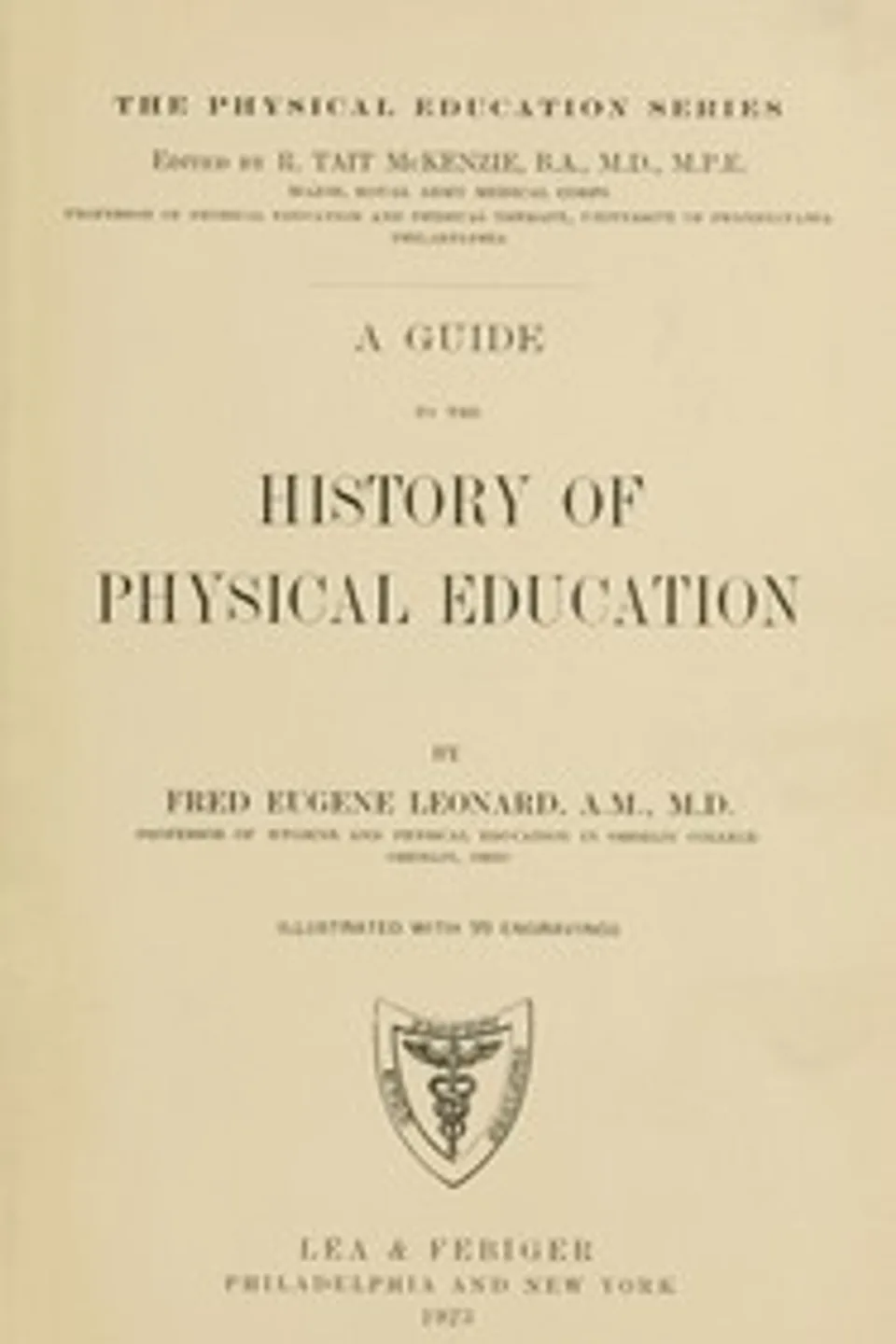
Read in English · with German
Read A guide to the history of physical education in English, with German beside it
by Fred Eugene Leonard · 1866–1922
"A guide to the history of physical education" by Fred Eugene Leonard is a scholarly historical survey written in the early 20th century. It traces how organized physical training developed from antiquity through European national systems to American movements, profiling key figures, institutions, practices, and ideas. Aimed at teachers and students, it synthesizes international scholarship and offers direction to authoritative sources. The opening of the volume frames its purpose and scope through a dedication to Edward Mussey Hartwell, the author’s preface recounting three decades of research and European study, and an editor’s preface urging historically informed practice over fads. A detailed contents map divides the work into Europe and the United States, then the first chapters survey the arc from Greece (Spartan and Athenian models, the palæstra and gymnasium, ephebic training, and the Olympic and other festivals) to Rome (utilitarian education, rigorous legionary drill, public baths, and the rise of spectacles). The narrative next sketches the hardy pursuits of the Teutonic peoples, the ascetic turn of early Christianity and its health and social effects, and the monastic and cathedral schools’ bookish focus and harsh discipline. It contrasts this with chivalry’s page‑to‑squire‑to‑knight regimen and tournaments, then shows how medieval universities prized scholastic disputation while discouraging games. Finally, the Renaissance and Reformation chapters introduce humanists and reformers who reasserted the value of exercise—most vividly in Vittorino da Feltre’s Mantua school—and medical and pedagogical voices (such as Cardano, Mercurialis, Luther, Zwingli, Camerarius, Comenius, Vives, Rabelais, and Montaigne) who argued for hygienic, military, and educational benefits of physical training.
Summary generated automatically by Project Gutenberg.
- Read time
- 634 min
- Words
- 139,462
- Chapters
- 87
- Paragraphs
- 1,615
- Price
- Free
- Physical education and training
- Physical education and training -- History
Abbot Gasquet, “English Monastic Life.”
Abt Gasquet, „English Monastic Life.“
London, Methuen & Co., 1904.
London, Methuen & Co., 1904.
Contains illustrations, maps, and plans.
Enthält Illustrationen, Karten und Pläne.
Herbert B. Workman, “The Evolution of the Monastic Ideal from the Earliest Times Down to the Coming of the Friars.”
Herbert B. Workman, „The Evolution of the Monastic Ideal from the Earliest Times Down to the Coming of the Friars.“
London, Charles H. Kelly, 1913.
London, Charles H. Kelly, 1913.
Questions about A guide to the history of physical education
Can I read A guide to the history of physical education in English with German side by side online?
Yes, free. Paralelo shows the English original with a German machine translation beside it, aligned phrase by phrase: hover or tap a phrase and its counterpart lights up in the other column. Anyone can read a passage; a free account opens the whole book.
What level do I need to read A guide to the history of physical education here?
There is no set level. A guide to the history of physical education runs to 139,462 words in 87 chapters, and the translation sits beside it, aligned phrase by phrase, so you can start below the level the original would need on its own and lean on the translation only where you stumble.
Is A guide to the history of physical education really free to read?
Yes. The text is in the public domain, and the translation and alignment are ours to give. A free account opens the whole book; the paid tier is for unlimited explanations.
Can I read A guide to the history of physical education in another language?
Not yet. Each language is its own translation and alignment run, and titles are queued by demand: open the book in that language and press “Ask for priority” to move it up the queue.
How long does A guide to the history of physical education take to read?
About 11 hours at a normal pace, longer if you stop to look at the alignment, which is rather the point.
Book details
- Original language
- English
- Translation
- German, machine translation
- Source text
- Project Gutenberg #78009
- Licence
- Public domain worldwide
Start A guide to the history of physical education today.
Free forever, no card. The whole library opens with an account.
Start reading, it's free