Read in English · with German
Read An Inquiry into the Nature and Causes of the Wealth of Nations in English, with German beside it
by Adam Smith · 1723–1790
"An Inquiry into the Nature and Causes of the Wealth of Nations" by Adam Smith is a treatise published in 1776. This foundational work of classical economics examines what builds nations' wealth at the dawn of the Industrial Revolution. Smith introduces revolutionary concepts like division of labor, free markets, and the "invisible hand" of self-interest guiding economic activity. Challenging the mercantilist policies of his era, he argues that supply and demand should determine commerce rather than government regulation, establishing theoretical foundations that would shape economic thought for centuries.
Summary generated automatically by Project Gutenberg.
- Read time
- 1725 min
- Words
- 379,502
- Chapters
- 32
- Paragraphs
- 2,187
- Price
- Free
- Economics
The vine is more affected by the difference of soils than any other fruit-tree.
Die Rebe wird durch den Unterschied der Böden stärker beeinflusst als jeder andere Obstbaum.
From some it derives a flavour which no culture or management can equal, it is supposed, upon any other.
Von einigen leitet sie einen Geschmack ab, den keine Kultur oder Bewirtschaftung zu übertreffen vermag, wie man annimmt, auf irgendeinem anderen.
This flavour, real or imaginary, is sometimes peculiar to the produce of a few vineyards; sometimes it extends through the greater part of a small district, and sometimes through a considerable part of a large province.
Dieser Geschmack, ob real oder eingebildet, ist manchmal nur dem Ertrag weniger Weinberge eigen; manchmal erstreckt er sich über den größten Teil eines kleinen Bezirks und manchmal über einen beträchtlichen Teil einer großen Provinz.
The whole quantity of such wines that is brought to market falls short of the effectual demand, or the demand of those who would be willing to pay the whole rent, profit, and wages,
Die gesamte Menge solcher Weine, die auf den Markt gebracht wird, bleibt hinter der effektiven Nachfrage zurück, oder der Nachfrage derjenigen, die bereit wären, den gesamten Pachtzins, Gewinn und die Löhne zu zahlen, die
necessary for preparing and bringing them thither, according to the ordinary rate, or according to the rate at which they are paid in common vineyards.
notwendig sind, um sie herzustellen und dorthin zu bringen, nach dem üblichen Satz oder nach dem Satz, der in gewöhnlichen Weinbergen gezahlt wird.
The whole quantity, therefore, can be disposed of to those who are willing to pay more, which necessarily raises their price above that of common wine.
Die gesamte Menge kann daher an diejenigen verkauft werden, die bereit sind, mehr zu zahlen, was ihren Preis notwendigerweise über den des gewöhnlichen Weins hebt.
The difference is greater or less, according as the fashionableness and scarcity of the wine render the competition of the buyers more or less eager.
Der Unterschied ist größer oder kleiner, je nachdem, wie die Modewelt und die Knappheit des Weins den Wettbewerb der Käufer mehr oder weniger eifrig machen.
Whatever it be, the greater part of it goes to the rent of the landlord.
Was auch immer es ist, der größte Teil davon geht an den Pachtzins des Grundbesitzers.
For though such vineyards are in general more carefully cultivated than most others, the high price of the wine seems to be, not so much the effect, as the cause of this careful cultivation.
Denn obwohl solche Weinberge im Allgemeinen sorgfältiger bewirtschaftet werden als die meisten anderen, scheint der hohe Preis des Weins nicht so sehr die Wirkung als vielmehr die Ursache dieser sorgfältigen Bewirtschaftung zu sein.
In so valuable a produce, the loss occasioned by negligence is so great, as to force even the most careless to attention.
Bei einem so wertvollen Ertrag ist der Verlust, der durch Fahrlässigkeit entsteht, so groß, dass er selbst die Unachtsamsten zur Aufmerksamkeit zwingt.
A small part of this high price, therefore, is sufficient to pay the wages of the extraordinary labour bestowed upon their cultivation, and the profits of the extraordinary stock which puts that labour into motion.
Ein kleiner Teil dieses hohen Preises reicht daher aus, um die Löhne der außergewöhnlichen Arbeit zu bezahlen, die auf ihre Bewirtschaftung verwendet wird, und den Gewinn des außergewöhnlichen Kapitals, das diese Arbeit in Bewegung setzt.
About the author
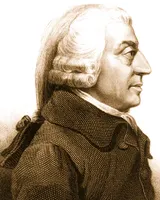
Adam Smith1723–1790
Adam Smith (1723–1790) was a Scottish economist and philosopher, a central figure of the Scottish Enlightenment.
The Adam Smith page, and where to start →Questions about An Inquiry into the Nature and Causes of the Wealth of Nations
Can I read An Inquiry into the Nature and Causes of the Wealth of Nations in English with German side by side online?
Yes, free. Paralelo shows the English original with a German machine translation beside it, aligned phrase by phrase: hover or tap a phrase and its counterpart lights up in the other column. Anyone can read a passage; a free account opens the whole book.
What level do I need to read An Inquiry into the Nature and Causes of the Wealth of Nations here?
There is no set level. An Inquiry into the Nature and Causes of the Wealth of Nations runs to 379,502 words in 32 chapters, and the translation sits beside it, aligned phrase by phrase, so you can start below the level the original would need on its own and lean on the translation only where you stumble.
Is An Inquiry into the Nature and Causes of the Wealth of Nations really free to read?
Yes. The text is in the public domain, and the translation and alignment are ours to give. A free account opens the whole book; the paid tier is for unlimited explanations.
Can I read An Inquiry into the Nature and Causes of the Wealth of Nations in another language?
Not yet. Each language is its own translation and alignment run, and titles are queued by demand: open the book in that language and press “Ask for priority” to move it up the queue.
How long does An Inquiry into the Nature and Causes of the Wealth of Nations take to read?
About 29 hours at a normal pace, longer if you stop to look at the alignment, which is rather the point.
Book details
- Original language
- English
- Translation
- German, machine translation
- Source text
- Project Gutenberg #3300
- Licence
- Public domain worldwide
Start An Inquiry into the Nature and Causes of the Wealth of Nations today.
Free forever, no card. The whole library opens with an account.
Start reading, it's free