Read in English · with German
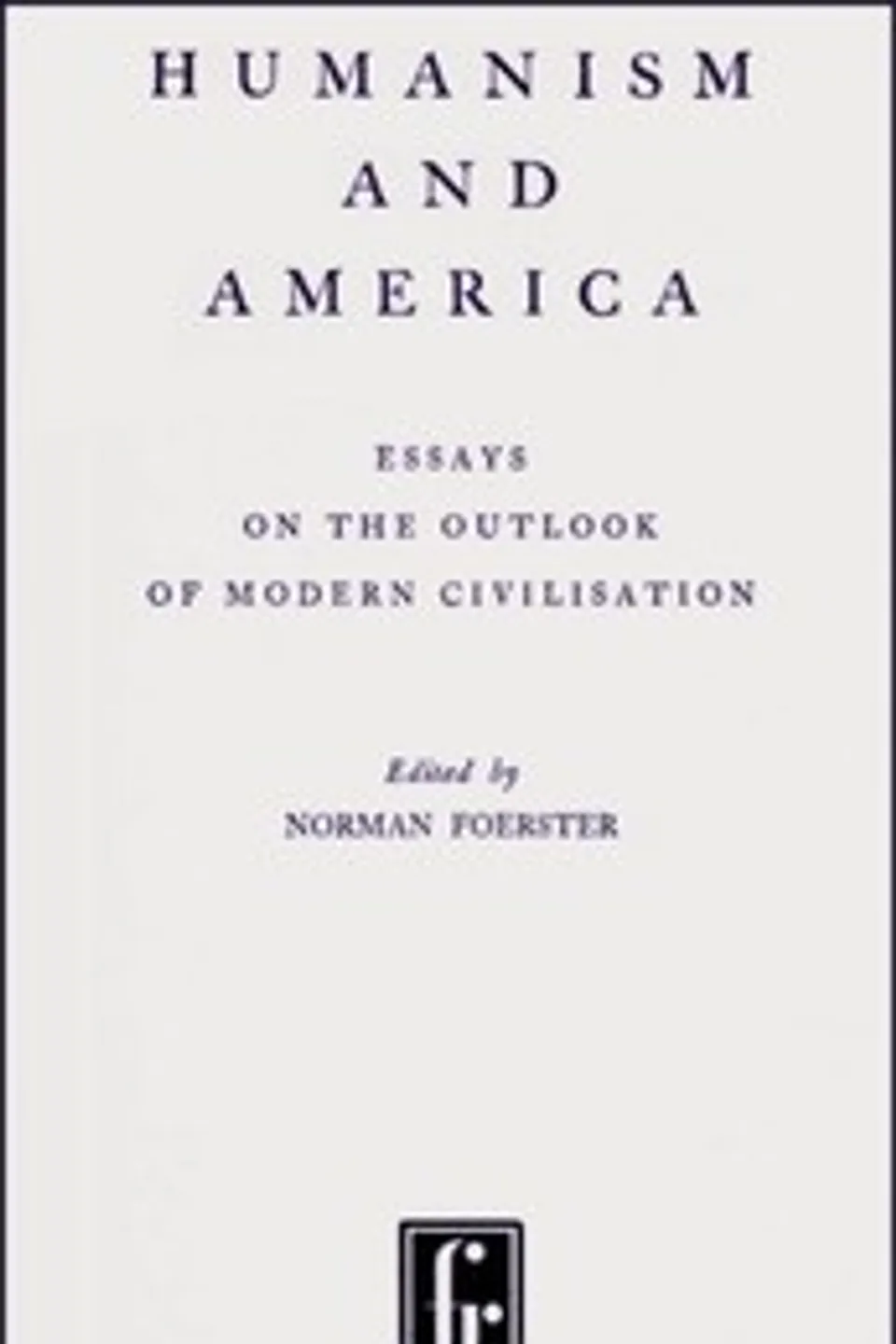
Read Humanism and America : $b Essays on the outlook of modern civilisation in English, with German beside it
"Humanism and America" by Norman Foerster is an edited collection of essays written in the early 20th century. It argues for a disciplined, classical humanism as a corrective to modern scepticism, scientism, and cultural disarray, especially in the United States. The volume surveys ethics, religion, literature, the arts, and education through contributions from leading critics and scholars. The opening of the collection presents a preface that diagnoses a modern “headache” of noise, disillusion, and naturism, and proposes humanism—defined by clear standards and a firm distinction between man, nature, and the divine—as a restorative discipline. The editor situates American humanism chiefly in the work of Irving Babbitt and Paul Elmer More, rebuts charges that humanists are academic, un-American, reactionary, or puritanical, and sets the book’s aim: to clarify terms, restore standards, and address contemporary life across the arts and public discourse. The first essay, by Louis Trenchard More, restricts true science to quantitative laws about the objective world, exposes the overreach of pseudo-sciences like psychology and sociology, retraces the historical split between objective method and subjective life from Galileo, Descartes, and Newton, and criticizes modern hypotheses (æthers, electrons, relativity, quanta) when treated as metaphysical truth. The next essay, by Irving Babbitt, defines humanism as allegiance to the law of measure, decorum, and poise—distinct from humanitarian sentiment—and argues for a stable centre in human nature, drawing parallels with Confucian thought, acknowledging religion’s support, and grounding ethics in a higher will that disciplines temperament. Together, these opening sections set the terms and program: replacing relativism and scientism with standards rooted in character, discrimination, and measure.
Summary generated automatically by Project Gutenberg.
- Read time
- 409 min
- Words
- 89,949
- Chapters
- 35
- Paragraphs
- 808
- Price
- Free
- Humanism
- Literature -- Philosophy
- Philosophy, Modern
- United States -- Civilization -- 20th century
I suspect that an utter confusion of thought has arisen here from the ambiguity of a word--as has happened immemorially with metaphysicians better and worse than Mr. Whitehead.
Ich vermute, dass hier eine völlige Verwirrung des Denkens aus der Mehrdeutigkeit eines Wortes entstanden ist – wie es unvordenklich mit Metaphysikern, besseren und schlechteren als Mr. Whitehead, geschehen ist.
Science as an accumulation and classification and utilisation of observed facts may go on from victory to victory;
Wissenschaft als Anhäufung, Klassifizierung und Nutzung beobachteter Fakten kann von Sieg zu Sieg ziehen;
but science as a name for such hypothetical theories of time and space, matter and motion and life, as those broached by the Darwinians of the nineteenth century, or the Einsteinian relativists of the twentieth,
aber Wissenschaft als Name für solche hypothetischen Theorien über Zeit und Raum, Materie und Bewegung und Leben, wie sie von den Darwinisten des neunzehnten Jahrhunderts oder den Einstein’schen Relativisten des zwanzigsten Jahrhunderts vorgebracht wurden
is not a progress in insight but a lapse from one naïve assumption to another in a vicious circle of self-contradicting monisms.
, ist kein Fortschritt in der Einsicht, sondern ein Verfallen von einer naiven Annahme zur anderen in einem teuflischen Kreislauf sich selbst widerlegenden Monismen.
It really is not easy to understand the state of mind of one, cognisant of the history of thought, who urges us to seek relief from the present débâcle--Mr.
Es ist wirklich nicht leicht, den Gemütszustand eines zu verstehen, der, der Geschichte des Denkens kundig, uns auffordert, Erleichterung von der gegenwärtigen débâcle zu suchen – Mr.
Whitehead himself places our intellectual and spiritual level lower than it has ever been since the Dark Ages--by introducing the hypothetical method of science into religion.
Whitehead selbst platziert unser intellektuelles und spirituelles Niveau niedriger, als es seit dem Mittelalter je war – indem er die hypothetische Methode der Wissenschaft in die Religion einführt.
This is his analysis of the present condition of the popular mind: “A scientific realism, based on mechanism,
Dies ist seine Analyse des gegenwärtigen Zustandes des allgemeinen Geistes: „Ein wissenschaftlicher Realismus, der auf Mechanismus basiert,
is conjoined with an unwavering belief in the world of men and of the higher animals as being composed of self-determining organisms.
wird mit einem unerschütterlichen Glauben an die Welt der Menschen und der höheren Tiere als aus selbstbestimmenden Organismen bestehend verbunden.
This radical inconsistency at the basis of modern thought accounts for much that is half-hearted and wavering in our civilisation.”
Diese radikale Inkonsistenz an der Basis des modernen Denkens erklärt viel von dem, was in unserer Zivilisation halbherzig und schwankend ist.“
My reading of history is different.
Meine Lesart der Geschichte ist eine andere.
I should assert that our vacillating half-heartedness is the inevitable outcome of the endeavour, persistent since the naturalistic invasion of the Renaissance, to flee from the paradox of life to some philosophy which will merge, no matter how,
Ich würde behaupten, dass unsere schwankende Halbherzigkeit die unvermeidliche Folge des Bestrebens ist, das seit der naturalistischen Invasion der Renaissance beständig war, vor dem Paradoxon des Lebens zu fliehen zu einer Philosophie, die, wie auch immer, das Mechanische und das Menschliche
the mechanical and the human together.
zusammenführt.
I should assert that the only escape from our muddle is to overthrow this idol of Unity, this Demon of the Absolute, this abortion sprung from the union of science and metaphysics,
Ich würde behaupten, dass die einzige Flucht aus unserem Durcheinander darin besteht, dieses Idol der Einheit, diesen Dämon des Absoluten, diese Abtreibung aus der Vereinigung von Wissenschaft und Metaphysik
and to submit ourselves humbly to the stubborn and irreducible fact that a stone and the human soul cannot be brought under the same definition.
zu stürzen, und uns demütig der hartnäckigen und irreduziblen Tatsache zu unterwerfen, dass ein Stein und die menschliche Seele nicht unter dieselbe Definition gebracht werden können.
There are two laws discrete Not reconciled,-- Law for man, and law for thing; The last builds town and fleet, But it runs wild, And doth the man unking.
Es gibt zwei getrennte Gesetze, nicht versöhnt,-- Gesetz für den Menschen, und Gesetz für das Ding; Das letzte baut Stadt und Flotte, Aber es läuft wild, Und entthront den Menschen.
Questions about Humanism and America : $b Essays on the outlook of modern civilisation
Can I read Humanism and America : $b Essays on the outlook of modern civilisation in English with German side by side online?
Yes, free. Paralelo shows the English original with a German machine translation beside it, aligned phrase by phrase: hover or tap a phrase and its counterpart lights up in the other column. Anyone can read a passage; a free account opens the whole book.
What level do I need to read Humanism and America : $b Essays on the outlook of modern civilisation here?
There is no set level. Humanism and America : $b Essays on the outlook of modern civilisation runs to 89,949 words in 35 chapters, and the translation sits beside it, aligned phrase by phrase, so you can start below the level the original would need on its own and lean on the translation only where you stumble.
Is Humanism and America : $b Essays on the outlook of modern civilisation really free to read?
Yes. The text is in the public domain, and the translation and alignment are ours to give. A free account opens the whole book; the paid tier is for unlimited explanations.
Can I read Humanism and America : $b Essays on the outlook of modern civilisation in another language?
Not yet. Each language is its own translation and alignment run, and titles are queued by demand: open the book in that language and press “Ask for priority” to move it up the queue.
How long does Humanism and America : $b Essays on the outlook of modern civilisation take to read?
About 7 hours at a normal pace, longer if you stop to look at the alignment, which is rather the point.
Book details
- Original language
- English
- Translation
- German, machine translation
- Source text
- Project Gutenberg #78119
- Licence
- Public domain in the United States
Start Humanism and America : $b Essays on the outlook of modern civilisation today.
Free forever, no card. The whole library opens with an account.
Start reading, it's free