Read in English · with German
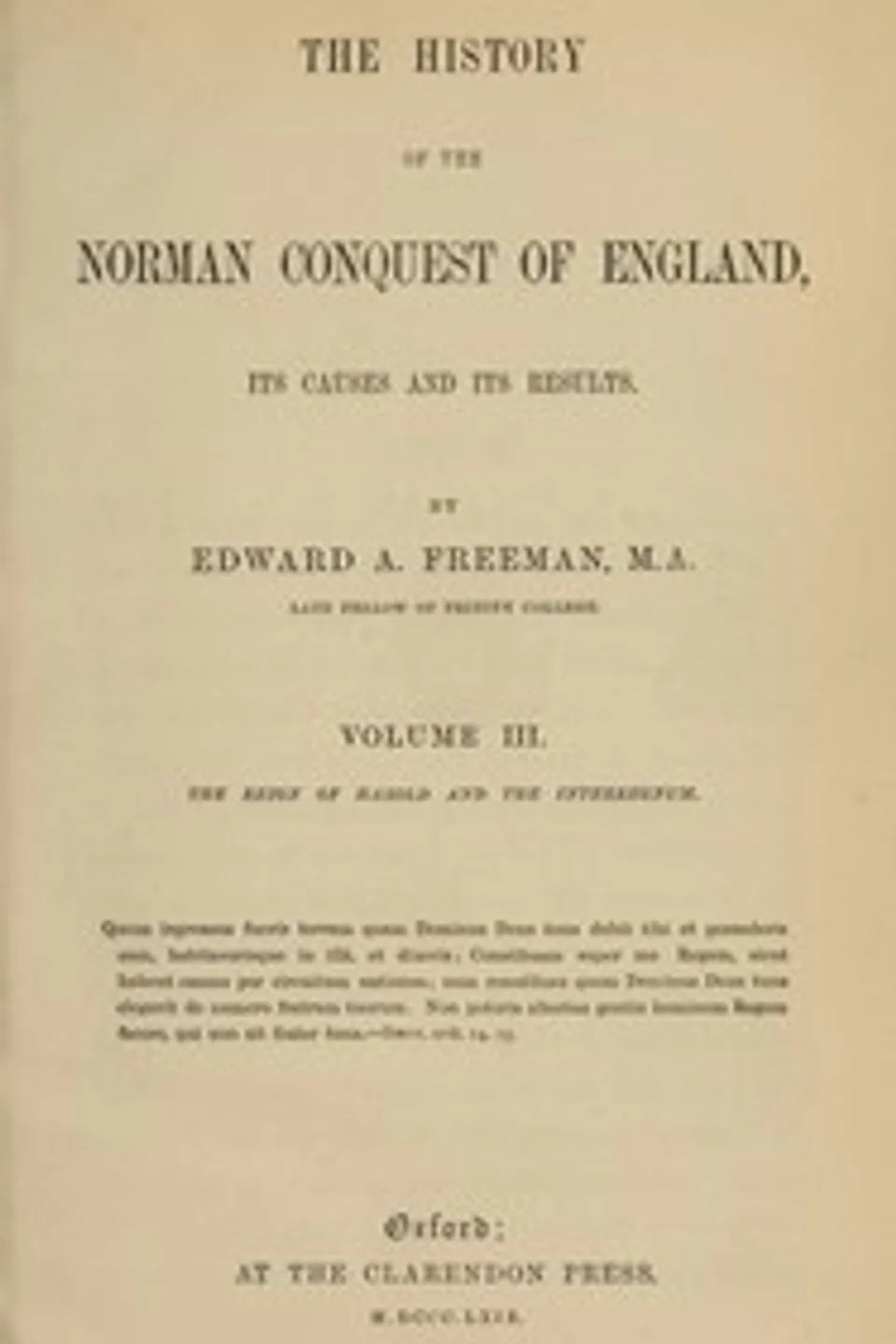
Read The history of the Norman conquest of England, its causes and its results, Volume 3 (of 6) in English, with German beside it
by Edward A. (Edward Augustus) Freeman · 1823–1892
The History of the Norman Conquest of England: Its Causes and Its Results is a six-volume study of the Conquest by Edward A. Freeman, published between 1867 and 1879. Recognised by critics as a major work of scholarship on its first publication, it has since proved unpopular with readers, many of whom were put off by its enormous length and copious detail. Academics have often criticized it for its heavily Whig treatment of the subject, and its glorification of Anglo-Saxon political and social institutions at the expense of their feudal successors, but its influence has nevertheless been profound, many Anglo-Norman historians of modern times having come around to some of Freeman's main conclusions. (This summary is from Wikipedia.)
Summary generated automatically by Project Gutenberg.
- Read time
- 1365 min
- Words
- 300,406
- Chapters
- 20
- Paragraphs
- 5,587
- Price
- Free
- Great Britain -- History -- Anglo-Saxon period, 449-1066
- Great Britain -- History -- Norman period, 1066-1154
- Hastings, Battle of, England, 1066
- Normans -- England
It is vain to discuss the merits of the choice.
Es ist vergeblich, die Vorzüge der Wahl zu diskutieren.
It could be justified only by the sad truths that any King was better than no King at all, and that at that moment no better King was forthcoming.
Sie konnte nur durch die traurigen Wahrheiten gerechtfertigt werden, dass jeder König besser war als gar kein König und dass im Moment kein besserer König in Sicht war.
There may even have been a faint hope that William might be satisfied with the overthrow of his personal enemy, and that he would not press his claims against a boy who had never wronged him,
Es könnte sogar eine schwache Hoffnung bestanden haben, dass Wilhelm mit der Niederlage seines persönlichen Feindes zufrieden sein und seine Ansprüche gegen einen Jungen, der ihn nie beleidigt hatte, nicht weiter verfolgen würde, ein Junge,
a boy who might pass as the heir, who was certainly the next of kin, of the deceased King for whom he professed so deep a reverence.
der als Erbe gelten konnte, der zweifellos der nächste Verwandte des verstorbenen Königs war, für den er so tiefe Verehrung bekundete.
How far the choice was strictly [Sidenote: Eadwine and Morkere agree to the election.] unanimous we know not.
Wie weit die Wahl streng [Seitenrand: Eadwine und Morkere stimmen der Wahl zu.] genommen einstimmig war, wissen wir nicht.
There is no doubt that Eadwine and Morkere, seeing no hopes of their own elevation, gave a formal consent to the election of Eadgar.[
Es besteht kein Zweifel, dass Eadwine und Morkere, da sie keine Hoffnungen auf ihre eigene Erhebung sahen, der Wahl Eadgars formell zustimmten.[
1520] On the [Sidenote: Opposition of some of the Bishops.] other hand we find it hinted that the Bishops opposed the choice of the Ætheling.[
1520] Auf der [Seitenrand: Widerspruch einiger Bischöfe.] anderen Seite wird angedeutet, dass die Bischöfe die Wahl des Æthelings ablehnten.[
1521] We know not how many of the English Bishops were at this time in London.
1521] Wir wissen nicht, wie viele englische Bischöfe sich zu dieser Zeit in London aufhielten.
It [Sidenote: The two Archbishops for Eadgar.] is certain that the two Primates, Stigand and Ealdred, were both present, and that both concurred in the election of Eadgar.[
Es [Seitenrand: Die beiden Erzbischöfe sind für Eadgar.] ist jedoch sicher, dass die beiden Primaten, Stigand und Ealdred, beide anwesend waren und beide der Wahl Eadgars zustimmten.[
1522] It would appear also that Wulfstan of Worcester and Walter of Hereford were also in the city.[
1522] Es scheint auch, dass Wulfstan von Worcester und Walter von Hereford ebenfalls in der Stadt waren.[
1523] [Sidenote: The opposition probably made by the foreign Bishops.]
1523] [Seitenrand: Der Widerspruch wurde wahrscheinlich von den ausländischen Bischöfen geäußert.]
Now we may be sure that any influence which belonged to the Bishop of the Diocese, the Norman William, would be exerted to hinder the election of Eadgar.
Nun können wir sicher sein, dass jeder Einfluss, der dem Bischof des Bistums, dem normannischen Wilhelm, zustand, ausgeübt wurde, um die Wahl Eadgars zu verhindern.
A Norman Prelate might now, without dishonour, recommend submission to the armed candidate of his own race.
Ein normannischer Prälat konnte nun, ohne sich zu schämen, die Unterwerfung unter den bewaffneten Kandidaten seiner eigenen Rasse empfehlen.
Even Wulfstan, the friend of Harold, might not feel himself equally bound to Eadgar, and his later conduct may perhaps show that, in face of the invasion of William,
Selbst Wulfstan, der Freund Harolds, fühlte sich Eadgar gegenüber vielleicht nicht gleichermaßen gebunden, und sein späteres Verhalten mag vielleicht zeigen, dass er angesichts der Invasion Wilhelms nicht unwahrscheinlich die Rolle Jeremias angesichts der
he was not unlikely to play the part of Jeremiah in face of the invasion of Nabuchodonosor.
Invasion Nebukadnezars spielen würde.
We may suspect too that the Lotharingian Prelate of Hereford, and his brethren of Wells and Sherborne, would not be specially zealous in the national cause.
Wir können auch vermuten, dass der lothringische Prälat von Hereford und seine Brüder von Wells und Sherborne nicht besonders eifrig in der nationalen Sache sein würden.
We need not suspect them of actual treason, but to exhort to submission to the Conqueror after the death of Harold would bear an aspect quite different from an attempt to weaken the national power of resistance while the King still lived.
Wir müssen sie nicht des eigentlichen Hochverrats verdächtigen, aber zur Unterwerfung unter den Eroberer nach dem Tod Harolds aufzurufen, würde einen ganz anderen Aspekt haben als der Versuch, die nationale Widerstandskraft zu schwächen, solange der König noch lebte.
Even a national and patriotic writer, speaking with the experience of a few weeks later, argues that an early submission would have been the wisest course.[
Sogar ein nationaler und patriotischer Schriftsteller, der mit der Erfahrung weniger Wochen später spricht, argumentiert, dass eine frühe Unterwerfung der klügste Kurs gewesen wäre.[
1524] The minds of foreign churchmen would be specially open to those spiritual influences which William had contrived to array on his side.
1524] Die Köpfe ausländischer Geistlicher wären für jene spirituellen Einflüsse besonders offen gewesen, die Wilhelm geschickt auf seine Seite gezogen hatte.
Nothing could be easier than to argue that, in the great assize of Senlac, the judgement of God had been visibly given on behalf of the invader,
Es wäre nicht schwer gewesen, zu argumentieren, dass im großen Gerichtstag von Senlac das Urteil Gottes sichtbar zugunsten des Eindringlings gesprochen worden sei
and that those who continued to fight against him would incur the guilt of fighting against God.
und dass diejenigen, die weiterhin gegen ihn kämpften, die Schuld auf sich laden würden, gegen Gott zu kämpfen.
About the author
Edward A. (Edward Augustus) Freeman1823–1892
Questions about The history of the Norman conquest of England, its causes and its results, Volume 3 (of 6)
Can I read The history of the Norman conquest of England, its causes and its results, Volume 3 (of 6) in English with German side by side online?
Yes, free. Paralelo shows the English original with a German machine translation beside it, aligned phrase by phrase: hover or tap a phrase and its counterpart lights up in the other column. Anyone can read a passage; a free account opens the whole book.
What level do I need to read The history of the Norman conquest of England, its causes and its results, Volume 3 (of 6) here?
There is no set level. The history of the Norman conquest of England, its causes and its results, Volume 3 (of 6) runs to 300,406 words in 20 chapters, and the translation sits beside it, aligned phrase by phrase, so you can start below the level the original would need on its own and lean on the translation only where you stumble.
Is The history of the Norman conquest of England, its causes and its results, Volume 3 (of 6) really free to read?
Yes. The text is in the public domain, and the translation and alignment are ours to give. A free account opens the whole book; the paid tier is for unlimited explanations.
Can I read The history of the Norman conquest of England, its causes and its results, Volume 3 (of 6) in another language?
Not yet. Each language is its own translation and alignment run, and titles are queued by demand: open the book in that language and press “Ask for priority” to move it up the queue.
How long does The history of the Norman conquest of England, its causes and its results, Volume 3 (of 6) take to read?
About 23 hours at a normal pace, longer if you stop to look at the alignment, which is rather the point.
Book details
- Original language
- English
- Translation
- German, machine translation
- Source text
- Project Gutenberg #78122
- Licence
- Public domain worldwide
Start The history of the Norman conquest of England, its causes and its results, Volume 3 (of 6) today.
Free forever, no card. The whole library opens with an account.
Start reading, it's free