Read in English · with German
Read The anatomy of revolution in English, with German beside it
by Crane Brinton · 1898–1968
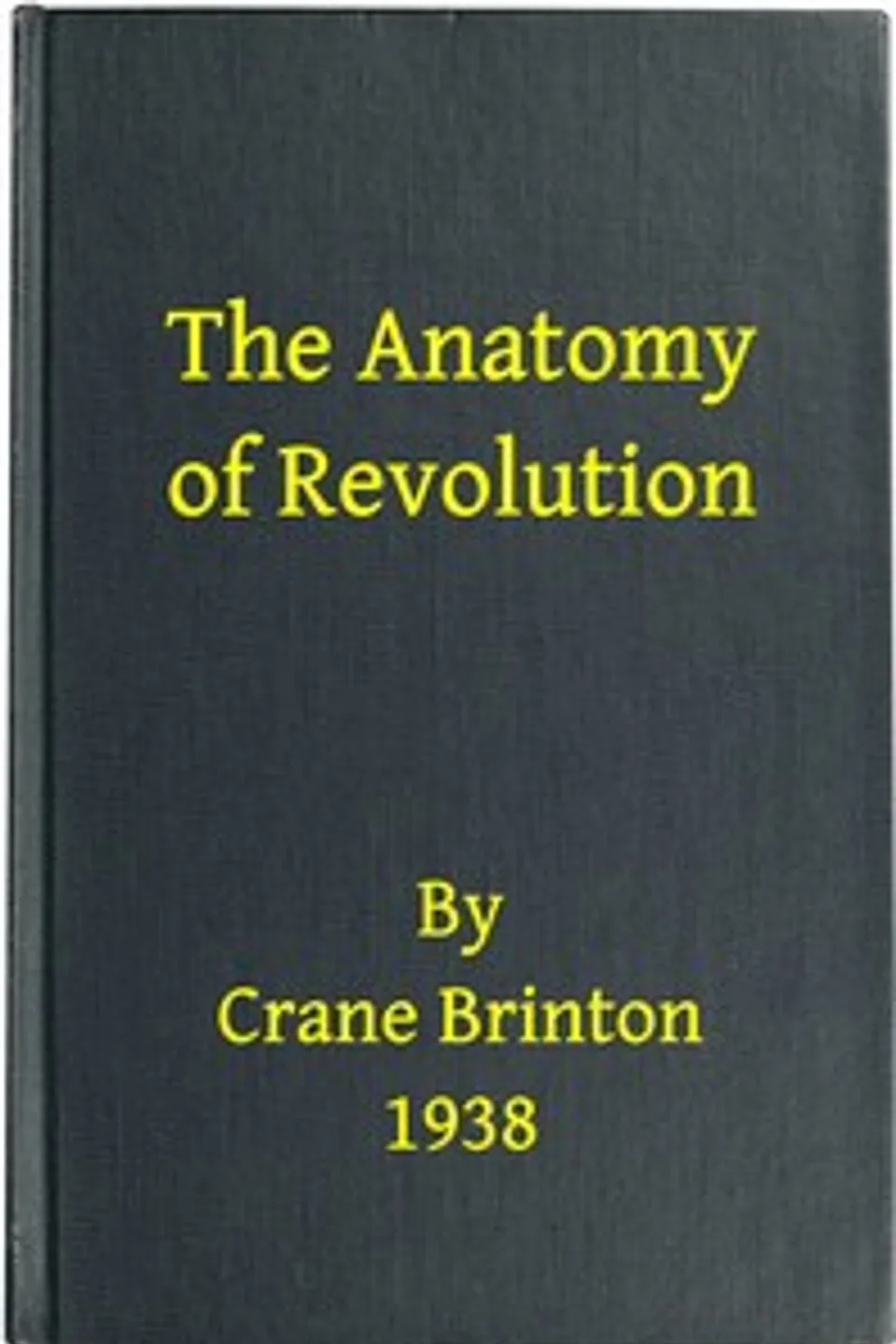
The Anatomy of Revolution is a 1938 book by Crane Brinton outlining the "uniformities" of four major political revolutions: the English Revolution of the 1640s, the American, the French, and the Russian revolutions. Brinton notes how the revolutions followed a life-cycle from the Old Order to a moderate regime to a radical regime, to Thermidorian reaction. The book has been called "classic, "famous", and a "watershed in the study of revolution" and has been influential enough to have inspired advice given to US President Jimmy Carter by his National Security Advisor Zbigniew Brzezinski during the Iranian Revolution. It has been referenced in the well-known text Political Science: An Introduction by Michael G. Roskin et al. A revised edition was published in 1952, a revised and expanded edition in 1965, and the book remains in print. Brinton summarizes the revolutionary process as moving from "financial breakdown, [to] organization of the discontented to remedy this breakdown … revolutionary demands on the part of these organized discontented, demands which if granted would mean the virtual abdication of those governing, attempted use of force by the government, its failure, and the attainment of power by the revolutionists. These revolutionists have hitherto been acting as an organized and nearly unanimous group, but with the attainment of power it is clear that they are not united. The group which dominates these first stages we call the moderates … power passes by violent … methods from Right to Left" (p. 253). (This summary is from Wikipedia.)
Summary generated automatically by Project Gutenberg.
- Read time
- 436 min
- Words
- 95,841
- Chapters
- 13
- Paragraphs
- 1,059
- Price
- Free
- Revolutions
Socialists and liberals alike were agreed that the Czar must abdicate.
Sowohl Sozialisten als auch Liberale waren sich einig, dass der Zar abdanken müsse.
Nicholas himself had started from Headquarters for his palace at Tsarskoe Selo near Petrograd, but was held up at Pskov by the increasing disorders.
Nikolaus selbst war vom Hauptquartier zu seinem Palast in Zarskoje Selo in der Nähe von Petrograd aufgebrochen, wurde aber in Pskow durch die zunehmenden Unruhen aufgehalten.
Here, on March 15th, he decided to abdicate in favor of his brother, the Grand Duke Michael.
Hier, am 15. März, beschloss er, zugunsten seines Bruders, des Großherzogs Michael, abzudanken.
What centralized power there was in Russia seems to have been in the hands of a committee of the Duma, and this committee waited on Michael in person.
Die zentrale Macht, die es in Russland gab, scheint in den Händen eines Ausschusses der Duma gewesen zu sein, und dieser Ausschuss suchte Michael persönlich auf.
Kerensky, who was on the committee, seems at this juncture to have been as neurotically dramatic as usual; at Michael’s refusal to accept the Crown he went into a transport of delight.
Kerensky, der im Ausschuss saß, scheint in diesem Augenblick so neurotisch dramatisch wie üblich gewesen zu sein; bei Michaels Weigerung, die Krone anzunehmen, geriet er in eine Wut der Freude.
Russia was to be a republic.
Russland sollte eine Republik werden.
Michael’s own decision to refuse seems to have been dictated by personal cowardice.
Michaels eigene Entscheidung zur Weigerung scheint von persönlicher Feigheit diktiert gewesen zu sein.
One of the nice problems of history in the conditional centers around the question of what would have happened had this Romanov been a man of courage, decision, and ability.
Eines der netten Probleme der Geschichte im Konditional dreht sich um die Frage, was passiert wäre, wenn dieser Romanow ein Mann mit Mut, Entschlusskraft und Fähigkeit gewesen wäre.
No one can say, but the question reminds us that even in its most sociological moments, history cannot neglect the drama of personality and chance.
Das kann niemand sagen, aber die Frage erinnert uns daran, dass die Geschichte selbst in ihren soziologischsten Momenten das Drama der Persönlichkeit und des Zufalls nicht vernachlässigen darf.
With Michael’s abdication on March 16, 1917, the Russian revolution had clearly begun.
Mit Michaels Abdankung am 16. März 1917 hatte die Russische Revolution eindeutig begonnen.
There were repercussions in the provinces, and in some remote spots the fall of the Romanovs was not realized for weeks.
Es gab Nachwirkungen in den Provinzen, und an einigen abgelegenen Orten wurde der Sturz der Romanows erst nach Wochen realisiert.
But the work of those eight days had destroyed a centralized bureaucratic government at its most vital point--its head and nerve-center.
Aber die Arbeit dieser acht Tage hatte eine zentralisierte bürokratische Regierung an ihrem vitalsten Punkt zerstört – ihrem Kopf und Nervenzentrum.
Much in Russia was unchanged by the February revolution, but politically a week had done what it had taken years to do in England and France.
Vieles in Russland war durch die Februarrevolution unverändert geblieben, aber politisch hatte eine Woche getan, was in England und Frankreich Jahre gedauert hatte.
The Romanovs had gone much more rapidly than the Stuarts and the Bourbons.
Die Romanows waren viel schneller gegangen als die Stuarts und die Bourbonen.
About the author
Crane Brinton1898–1968
Clarence Crane Brinton was an American historian of France and ideas, born in Winsted in 1898 and died in Cambridge in 1968.
The Crane Brinton page, and where to start →Read it in another language
Questions about The anatomy of revolution
Can I read The anatomy of revolution in English with German side by side online?
Yes, free. Paralelo shows the English original with a German machine translation beside it, aligned phrase by phrase: hover or tap a phrase and its counterpart lights up in the other column. Anyone can read a passage; a free account opens the whole book.
What level do I need to read The anatomy of revolution here?
There is no set level. The anatomy of revolution runs to 95,841 words in 13 chapters, and the translation sits beside it, aligned phrase by phrase, so you can start below the level the original would need on its own and lean on the translation only where you stumble.
Is The anatomy of revolution really free to read?
Yes. The text is in the public domain, and the translation and alignment are ours to give. A free account opens the whole book; the paid tier is for unlimited explanations.
Can I read The anatomy of revolution in another language?
Yes. It is also published in Spanish, and switching keeps your place, because both columns share one paragraph numbering.
How long does The anatomy of revolution take to read?
About 7 hours at a normal pace, longer if you stop to look at the alignment, which is rather the point.
Book details
- Original language
- English
- Translation
- German, machine translation
- Source text
- Project Gutenberg #78065
- Licence
- Public domain in the United States
Start The anatomy of revolution today.
Free forever, no card. The whole library opens with an account.
Start reading, it's free