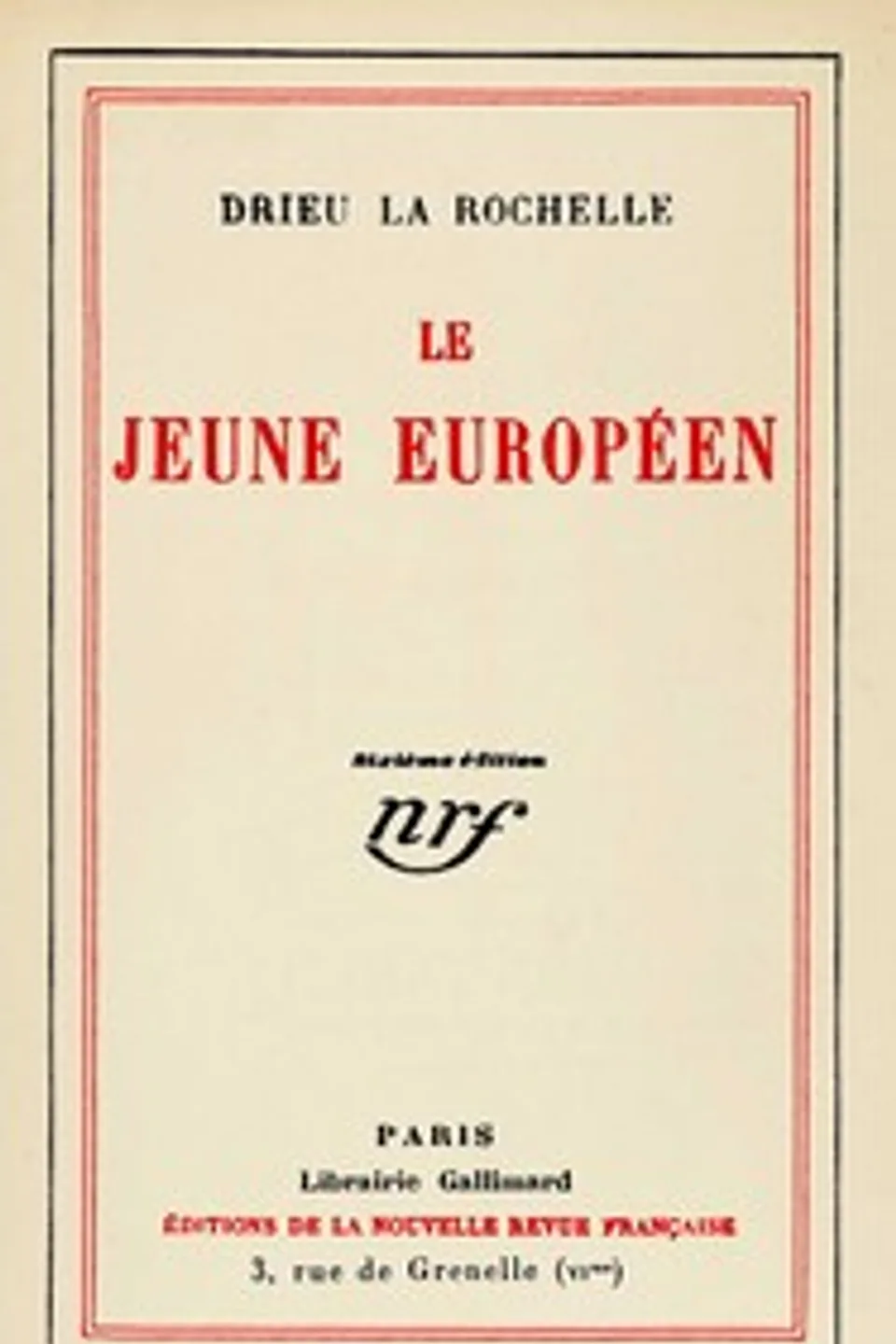
Read in French · with English
Read The Young European in French, with English beside it
Original title: Le jeune Européen
by Pierre Drieu La Rochelle · 1893–1945
"Le jeune Européen" by Pierre Drieu La Rochelle is an autobiographical essay written in the early 20th century. It follows a cosmopolitan narrator—the self-styled “young European”—through war, pleasure, revolution, and self-scrutiny, as he wrestles with identity, modern Europe’s drift, and the pull between action and art. Through confessional scenes and sharp reflections, the work probes violence, desire, faith, and the seduction and ruin of literature. The opening of the book presents a restless first-person life: an uncertain parentage, a rich and hedonistic youth across Europe, then the shock of 1914 and enlistment in the French infantry. The narrator embraces patrols, terror, and a mystic exaltation, then grows disillusioned, deserts via the German lines, escapes through Switzerland, kills for a passport, and flees to America, where marriage, money, and athletic bodies prove empty. Drawn to Russia, he rides the revolutionary wave, fights in border wars, and leaves disenchanted by a clumsy, American-style industrial creed, returning to Paris with money and fatigue. There he sinks into “paresse,” drifting through nocturnal Paris while diagnosing mass spectacle, consumer life, and his own isolation, and he relives a lifelong tug-of-war with books and the urge to write. He first writes about his past, then bungles a “novel” (Finette and Gille) that collapses into confession—published as a dull, uneven book with a few raw pages of blood. Learning from failure, he turns to “écrire pour vivre,” hoping to sing others rather than himself, yet keeps debating subjectivism, action, and the role of art, closing this opening stretch by longing to be fully a man—athlete, friend, lover, and artist—despite feeling thwarted.
Summary generated automatically by Project Gutenberg.
- Read time
- 141 min
- Words
- 30,929
- Chapters
- 44
- Paragraphs
- 610
- Price
- Free
- French essays
Ou bien perché dans le cintre d’un cirque, du point de vue de Sirius, je regarde en bas le combat de boxe.
Or perched in the rigging of a circus, from the viewpoint of Sirius, I look down at the boxing match.
Sur un plateau, deux petits hommes se cognent.
On a platform, two little men bang at each other.
Les projecteurs, qui tiennent cruellement dans leur lumière ce drame minuscule, pendent du plafond céleste comme la douzaine d’yeux d’un monstrueux savant nocturne, penché sur son microscope.
The spotlights, which cruelly hold in their light this microscopic drama, hang from the celestial ceiling like the dozen eyes of a monstrous nocturnal scientist, leaning over his microscope.
La foule, énorme et lubrique, s’échauffe: elle voit deux armées.
The crowd, enormous and lustful, heats up: it sees two armies.
A bon compte, elle hume un vieux fumet de guerre ou d’émeute.
At a bargain price, it inhales an old whiff of war or riot.
Il est agréable d’être à l’abri des coups.
It is pleasant to be sheltered from blows.
Au cinéma, ils se rassemblent pour rêver encore, et plus à leur aise.
At the cinema, they gather to dream again, and more comfortably.
Contre la paroi de l’écran, bat ce poisson nostalgique.
Against the wall of the screen, this nostalgic fish beats.
De l’autre côté, c’est la liberté.
On the other side, it is freedom.
Non, c’est le passé.
No, it is the past.
On regarde un film comme sa jeunesse.
One watches a film like one’s youth.
Assis sur les genoux des ténèbres, ils ressassent leur quotidien: amours et enterrements.
Sitting on the knees of darkness, they chew over their daily lives: loves and funerals.
Ils n’osent tuer et incendier qu’en rêve.
They dare not kill and burn except in dreams.
Voir Melbourne et mourir.
See Melbourne and die.
«Allo!
"Hello!
Donnez-moi mon antipode.
Give me my antipode.
Remplissons notre devoir jusqu’au bout.
Let us fulfil our duty to the end.
Allo!
Hello!
Sidney?
Sydney?
Mr. Brandbury?
Mr. Brandbury?
Avez-vous passé une bonne nuit?
Did you have a good night?
Il tombe un soir charmant sur Paris.
A charming evening falls on Paris.
Et vos moutons?
And your sheep?
Cet incendie qui éclate au cinéma des Batignolles, pouvez-vous le circonscrire?
That fire breaking out at the Batignolles cinema, can you contain it?
Allons, tant mieux.
Come on, all the better.
Mes hommages à Mrs. Brandbury.»
My compliments to Mrs. Brandbury."
Toutes les semaines je retrouve ce cavalier et son galop immobile, comme le facteur, au coin de la rue.
Every week I meet this rider and his stationary gallop, like the postman, at the corner of the street.
Des secrétaires, sourds-muets, rapportent au propriétaire des journaux ce que l’homme a fait dans sa journée.
Secretaries, deaf-mutes, report to the newspaper owner what the man has done during his day.
Relié par fil spécial avec le monde entier: ô puissance catholique.
Wired by special line to the whole world: O Catholic power.
Regardez-le, coiffé de ses antennes, ce pape.
Look at him, crowned with his antennas, this pope.
Il se frotte les mains et prépare tout.
He rubs his hands and prepares everything.
Il pense ce que pensera demain l’homme dans la rue, la femme, le chien, le perroquet.
He thinks what tomorrow the man in the street, the woman, the dog, the parrot will think.
D’heure en heure, la pensée rattrape l’événement.
Hour by hour, thought catches up with the event.
Mais non, les journaux sont imprimés à l’avance.
But no, the newspapers are printed in advance.
Tout se passe comme il est écrit.
Everything happens as it is written.
About the author
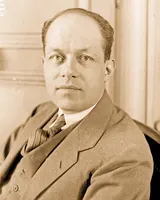
Pierre Drieu La Rochelle1893–1945
Pierre Eugène Drieu La Rochelle was a French writer of novels, short stories, and political essays, born in Paris in 1893 and dying there in 1945.
The Pierre Drieu La Rochelle page, and where to start →Questions about The Young European
Can I read The Young European in French with English side by side online?
Yes, free. Paralelo shows the French original with a English machine translation beside it, aligned phrase by phrase: hover or tap a phrase and its counterpart lights up in the other column. Anyone can read a passage; a free account opens the whole book.
What level do I need to read The Young European here?
There is no set level. The Young European runs to 30,929 words in 44 chapters, and the translation sits beside it, aligned phrase by phrase, so you can start below the level the original would need on its own and lean on the translation only where you stumble.
Is The Young European really free to read?
Yes. The text is in the public domain, and the translation and alignment are ours to give. A free account opens the whole book; the paid tier is for unlimited explanations.
Can I read The Young European in another language?
Not yet. Each language is its own translation and alignment run, and titles are queued by demand: open the book in that language and press “Ask for priority” to move it up the queue.
How long does The Young European take to read?
About 2 hours at a normal pace, longer if you stop to look at the alignment, which is rather the point.
Book details
- Original language
- French
- Translation
- English, machine translation
- Source text
- Project Gutenberg #78063
- Licence
- Public domain worldwide
Guides that recommend books in French
All guides →More originally in FrenchSame language, same shelf
Start The Young European today.
Free forever, no card. The whole library opens with an account.
Start reading, it's free